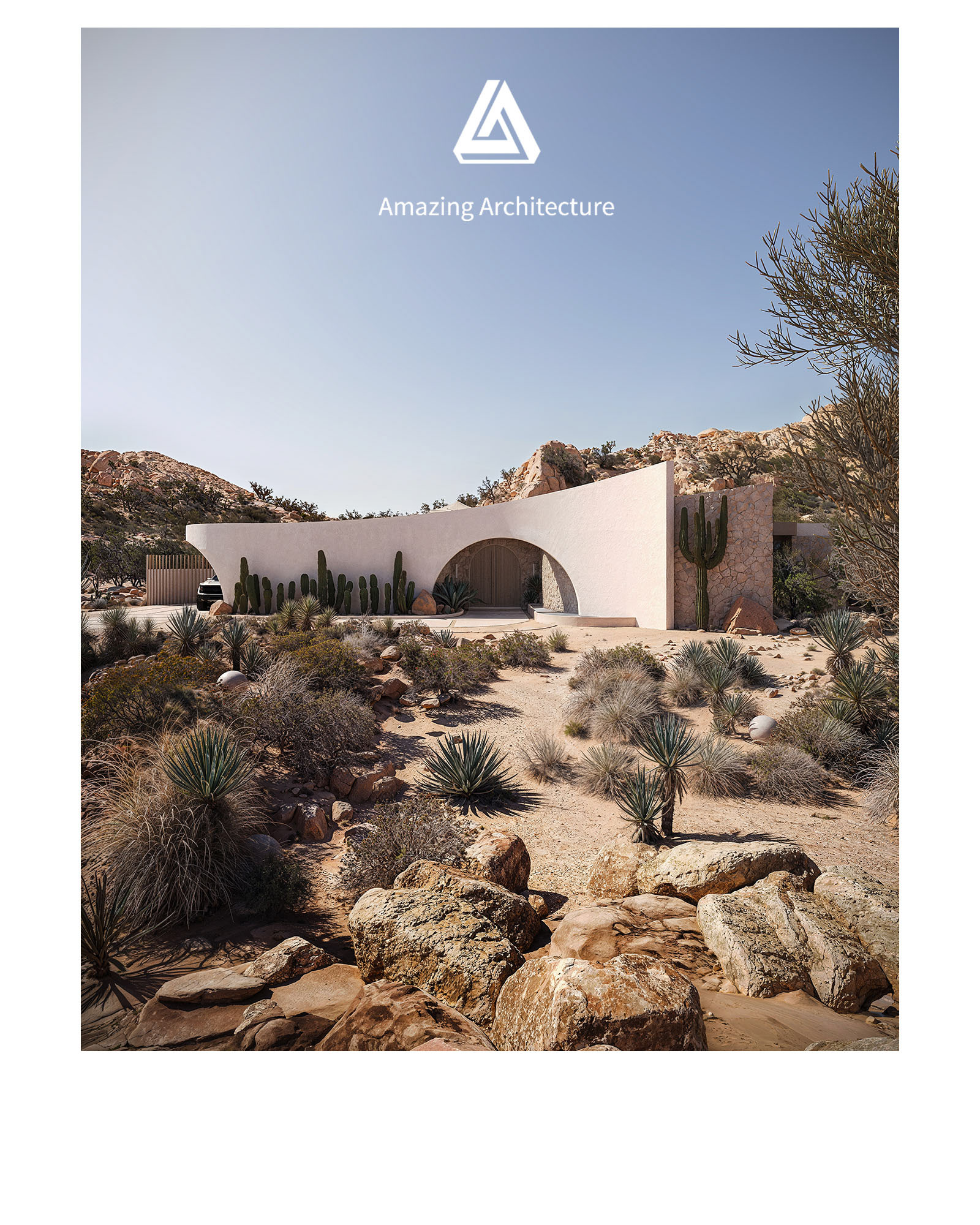
Diachok Architects: This project is an exploration of how to live in a powerful desert landscape without being overwhelmed by it. Joshua Tree is defined by exposure: intense light, open horizons, dry air, and a scale that constantly reminds a person of their physical smallness. Rather than amplifying these qualities, the house is conceived as a spatial filter — a structure that moderates the environment and creates conditions for calm, inhabitable life.
The architecture is inward-looking by intention. From the outside, the building reads as a protected volume, limiting visual and climatic exposure. Once inside, spaces open gradually toward an inner courtyard and the sky. This shift changes how the body responds to the environment: movement slows, attention narrows, and the constant need to react to external stimuli disappears. The house does not frame the desert as a spectacle; it allows the desert to exist at a distance.
Interior spaces are organized around horizontality, mass, and human scale. A low center of gravity and restrained geometry create a sense of stability and physical comfort. The space feels supportive rather than expansive, reducing the psychological pressure often associated with open-plan desert homes. Materials are chosen for their tactile and absorptive qualities. Wood, textiles, and matte surfaces soften light, allowing the interior to function as a calm, continuous environment rather than a collection of visual statements.
The inner courtyard serves as the emotional core of the house. Enclosed and private, it provides a controlled outdoor space where water, shade, and sky coexist without exposure. The pool moderates temperature and light, while the fireplace introduces warmth and ritual in the evening, encouraging stillness and shared presence. Overall, the project prioritizes long-term comfort over immediate impact. It is a house designed not for constant stimulation, but for recovery, presence, and everyday life. By reducing intensity rather than increasing it, the architecture allows occupants to reconnect with the landscape on their own terms — quietly, gradually, and without strain.